 |
Porto HERITAGE TRAMS April 2026 |
|
| This Page History Route 1 Route 18 Car 274 Ticket Metro Sources Thanks Read Me |

Aim of This Page
It was during the 1990s, when I visited Porto on a number of occasions, that I became aware of the once large tram network serving Portugal's second city and a commercial hub. It was just before the age of digital photography.
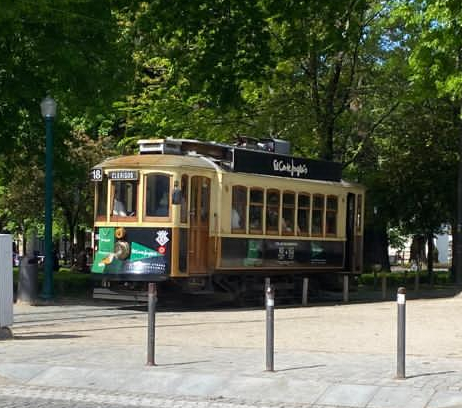
Brill Car on a sunny April Afternoon
Route 18 en route to "Carmo"
(date: 2026-04-18 @10:36)
My neighbours made a recent visit to Porto and kindly offered to take some pictures with their cell phone. This was an offer I could not refuse, since it enabled me to relive some of my past experiences and put them on my website. To respect their privacy, I have not mentioned my neighbours by name or address.
The "diamond and circle" motif is reminiscent of the STCP Logo, but simplified for legal and presentational reasons!
Porto Trams - A Potted History
Electrification in Porto began early. The original mule-drawn "American Cars" started to be converted to electric propulsion from 1895. Eventually, classic American trams, using the Brill 21E four wheel, truck were introduced. This American design (body and truck), appeared essentially on four of the five main Portuguese tram networks. The Porto fleet was also subsequently augmented by bogie cars, including the "Belgian" cars of 1928.
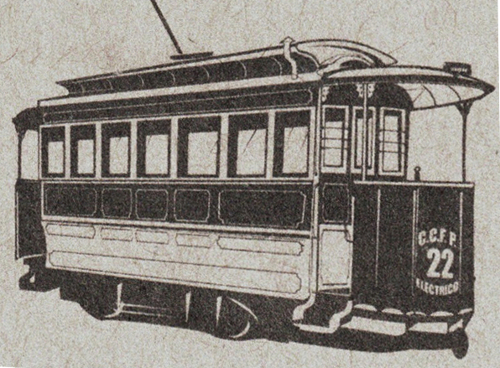
an early electric tram - essentially a motorised horse drawn Carro Americano".
This picture is from the ticket pictured below.
Three routes, 1, 18 and 22, of the original network remain as tourist attractions. Route 22 is temporarily closed to allow further work on the Porto Metro.
Porto Trams - Heritage Route 1
Route one is the first electric tram route in Porto. It was inaugurated in 1895, twenty years after the first mule tram route followed by number 18, described below. Route 1 stretches along the scenic Banks of the Douro from Infante in downtown Porto, out towards the Atlantic coast, to Passeio Alegre in the fashionable and tourist Foz district. "Foz de Douro" means "Mouth of the Douro". "Infante" refers to Prince Henry the Navigator.
Four wheel car number 220 at Infante.
This tram was built in Porto between about 1938 and 1945.
It was similar to the cars built by J.G. Brill Co., but had longer platforms.
It is a "Brill-28" type car. See: Porto_tram_type_200-223.
The photographer sees the points as convergent (trailing), and the point frog indicates that these points are preset. Both the points and the attachment of the trolley pole to the wire indicate that when the car leaves for Passeio Alegre, it will take the (inner) track, furthest from the river Douro.
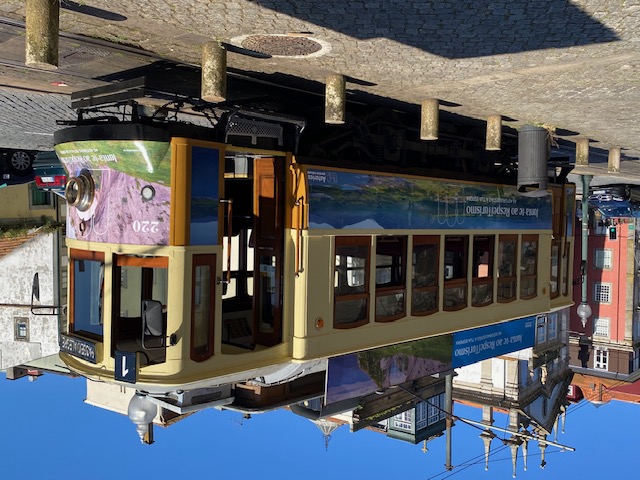
Four wheel car number 220 at Infante.
Trolley pole has been repositioned in readiness
for the return to Passeio Alegre
to the West (towards the Atlantic) along the Douro.
(date: 2026-04-16)
Porto Trams - Heritage Route 18
Route 18 connects with route 1 at the Tram Museum, and heads inwards to Carmo. At Carmo, it meets the 30 minute circular route 22, which is presently temporarily closed during the construction for the Porto Metro. Both routes 18 and 22 negotiate steep hills, the steepness showing the electric heritage trams to their advantage! Line 18 between Carmo and the Tram Museum at Massarelos was the first tram line in Porto, opened in September 1875, served by mule-drawn trams (American Cars) and known as the "Restoration Line", probably to celebrate Portugal's independence from Spain in the years 1640-1668.
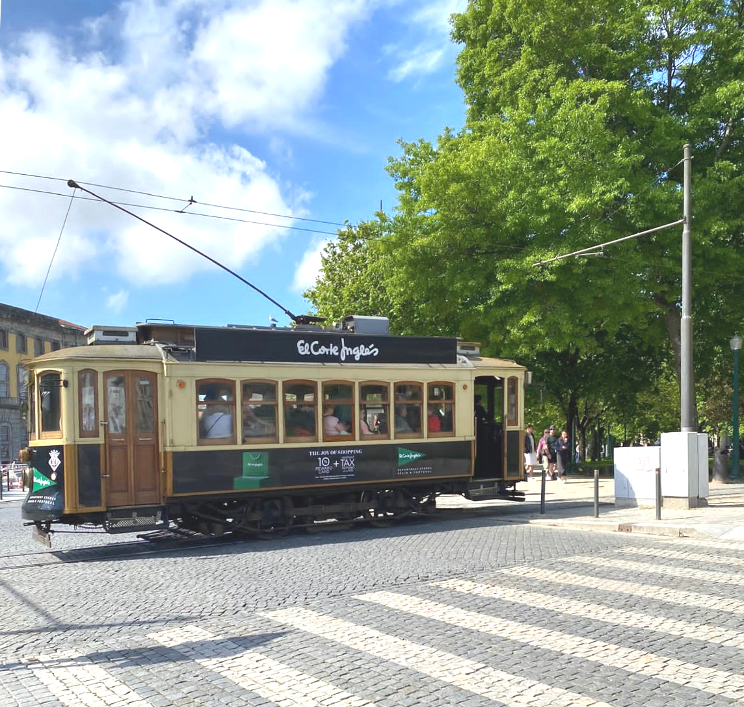
En route to Igreja do Carmo (city center)
About to enter the Jardim João Chagas
also known as the Jardim da Cordoaria.
The number of the car cannnot be descerned, but
it appears to be of the same type as number 220 above.
El Corte Ingles is the well known Spanish retail store
(like Binns in the North of England).
In Porto it is in Vila Nova da Gaia on Metro Line 6.
(date: 2026-04-18 @10:36)
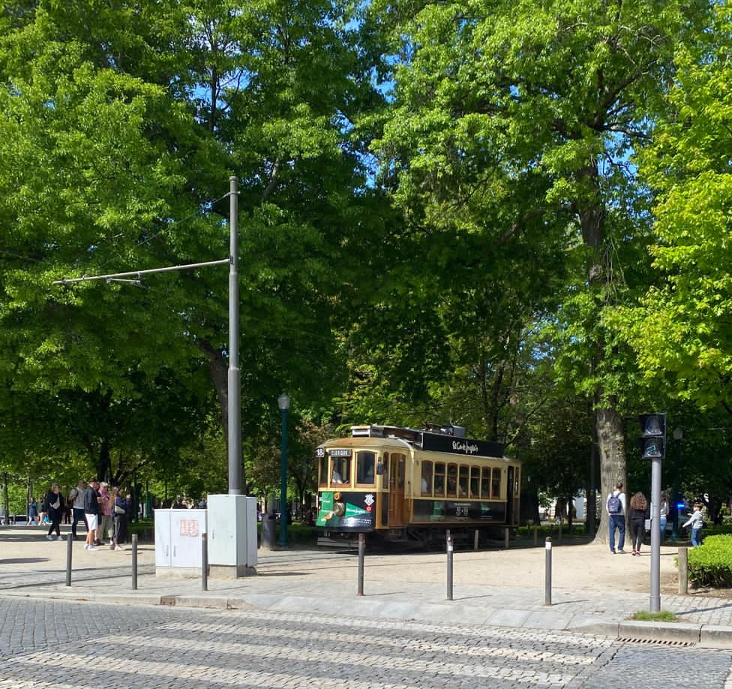
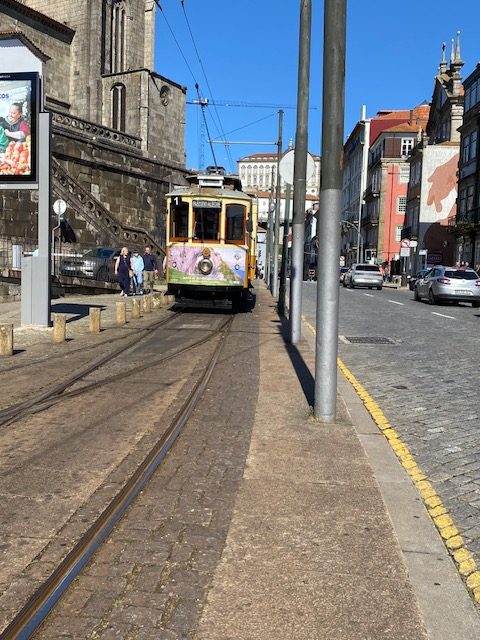
En route to Igreja do Carmo (city center)
About to enter the Jardim João Chagas
also known as the Jardim da Cordoaria
(date: 2026-04-18 @10:36)
Porto Trams - Bogie Number 274
Car 274 is usually based at the Porto tram museum. The car was built in Porto by CCFP in 1928, and belongs to the class known as "Bogie Americano" (series 270-277). Number 274 has an interesting "grid fender" arrangement at both ends. A similar car, Number 273, with a more conventional fender, is at UK's Crich museum. Other cars, even "more similar" to number 274, but also with more conventional fenders, are numbers 275 and 277. (See Type 270-277 ).
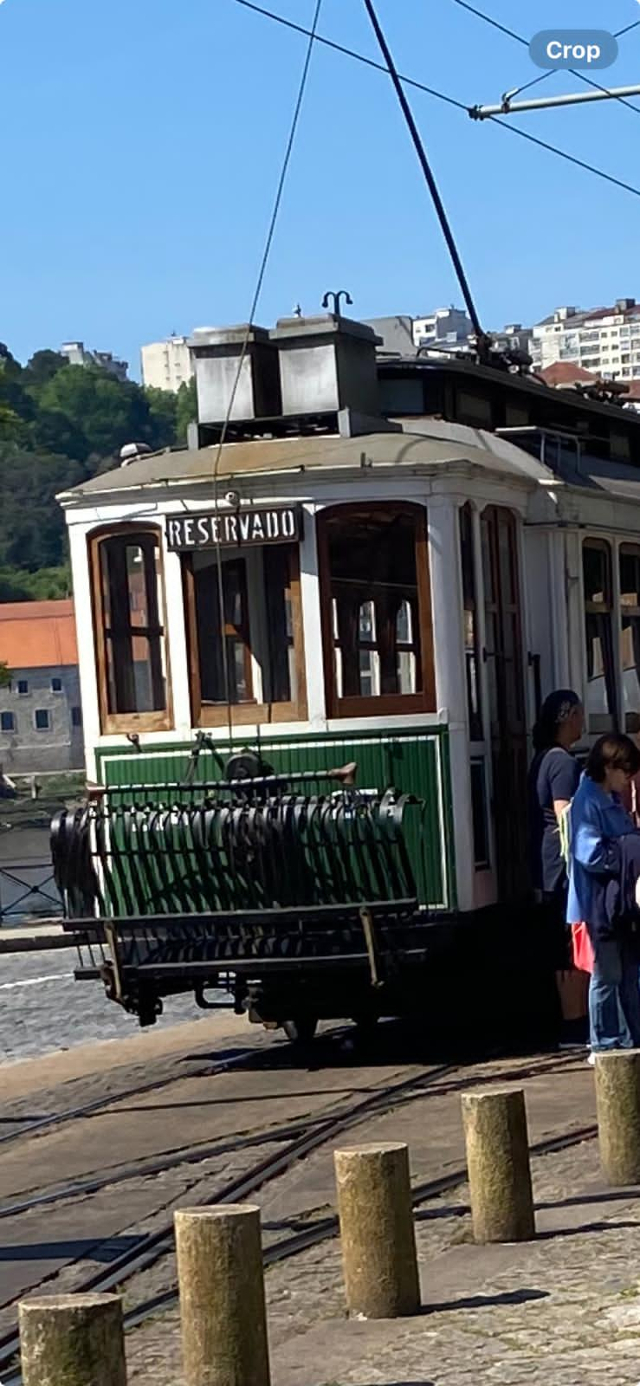
Car 274 is at Passeio Alegre, waiting for a special evening trip.
Passeio Alegre is actually on route 1, but this picture was taken
just before the photographer was leaving Porto,
and so, is included here!
(date of above picture: 2026-04-18 @18:59)
Commemorative Ticket
This is for route 1 which went up the hill to the depot at Boa Vista, in the late 1990s. "1E" was used to distinguish the tram route from the bus route, which was subsequently renumbered 500. Luckily, it was decided to preseve some of Porto's interesting tramway heritage for future generations - including tourists! - to enjoy and appreciate.
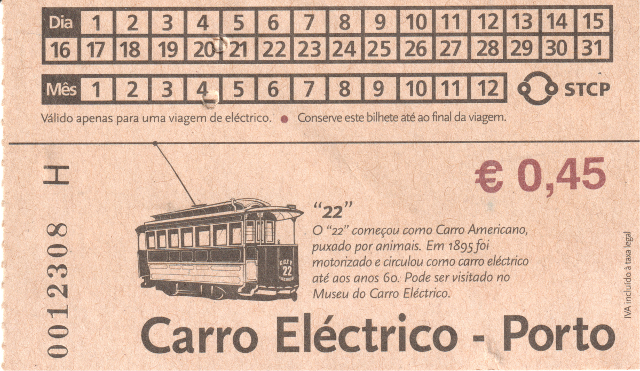
Special Ticket for when route 1 (as 1E)
went to the depot at Boa Vista,
in the late 1990s.
|
The description on the ticket gives a potted history of tramway operation in Porto,
which was an early innovator in electric urban transport. "Car number 22 [as depicted] started its career as an "American Car", hauled by animals [probably mules]. In 1895 it was motorised and operated as an electic tram for 60 years. It can be seen in the Tram Museum." |
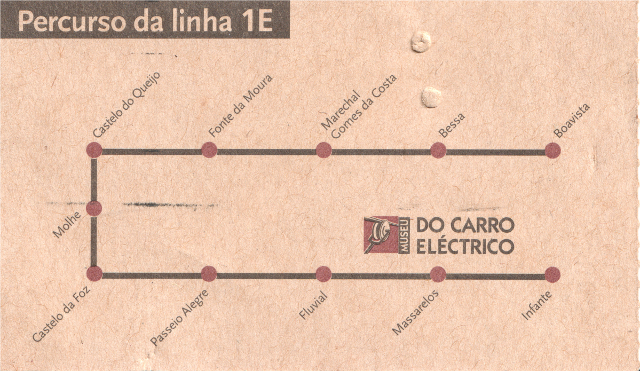
Special Ticket for when route 1 (as 1E)
went to the depot at Boa Vista.
Porto Metro
For completeness, the Porto Metro should get a look-in on this page. At present it consists of six routes, with about one third in tunnels. It includes the route over the Douro, across the iconic Dom Luis I Bridge, built by a pupil of Gustav Eiffel. Rolling stock consists of a variety of articulated trams, typically of 3 and 5 "segments" each. The new trams preserve the ability of historical trams in enabling hilly terrains and sharp bends to be traversed. As trams, it is also possible to operate them safely quite close to pedestrian areas such as on the Dom Luis I Bridge. Basing the new metro on trams, thus has an engineering, deployment and cost advantage over conventional railways and metros.
Some References
- Sociedade de Transportes Colectivos do Porto
- Porto Tram Museum
- Porto Tram Guide
- Brill 21 E - Four Wheel Truck
- Trams in Porto by type (Meta Page)
- Martins, Thesis, Uni Porto, 2007
- National Tramway Museum (UK): Oporto 273
- National Tramway Museum (UK): Carro Americano
Thank You
I I would like to thank my neighbours, who, at my request were able to take the pictures you see on this page. They had just three nights in Porto, with much to do and see, but found some moments to take these pictures. Many Thanks Indeed!

Eric Scharf
Original: 2026-04-15 @17:00
Latest: 2026-04-26 @15:02
SAGAX REX HANC RETIS ORBIS PAGINAM PINXIT ANNO MMXXVI.